
The EcoDharma Teacher Certificate Course from One Earth Sangha is offered as a groundbreaking training for modern Buddhist and mindfulness teachers who wish to bring the living Earth, climate realities, and the polycrises of colonial modernity into their teaching and communities with wisdom, courage, and care.
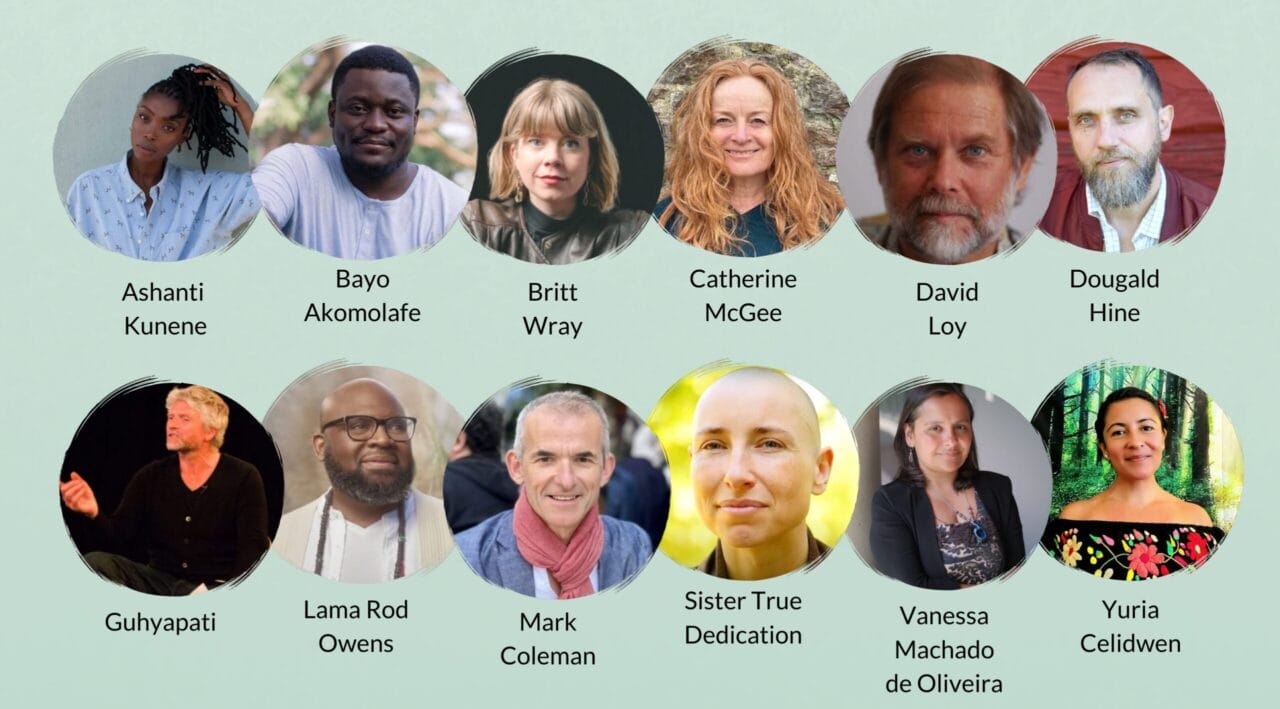
Featuring leading teachers, authors, and organizers offering deep wisdom for a world in transition:
In today’s world, it can feel overwhelming—or even divisive—to address ecological collapse, climate grief, or cultural trauma within spiritual spaces. This program offers the skills and inner grounding needed to meet these challenges without falling into despair, denial, or moral righteousness. Instead, teachers will learn to embody resilience, compassion, and clarity in ways that sustain communities through turbulent times. The crises can be transformed into possibilities.
The course unfolds in three phases:
- Personal Depth Work — Exploring our own hearts, assumptions, and worldviews to metabolize the complexities of this era.
- Earth as Teacher — Entering a land-based contemplative retreat where the more-than-human world guides our practice.
- Skills for Service — Training in best practices for facing eco-distress, facilitation, group process, and local ethical engagement, equipping teachers to lead communities with maturity and inspiration.
Participants will encounter the depth of Buddhist ecological teachings, embodied nature-practices, and compassionate ethics, in dialogue with thought leaders, Indigenous wisdom holders, eco-psychologists, and leading ecological thinkers. Together we ask: What is the role of Dharma in this time of profound change?
Graduates emerge as certified EcoDharma Teachers—mature, wakeful, and resilient leaders, able to guide communities through the grief and possibility of our times, and to turn the Dharma wheel toward an ecological and compassionate future.
2026 Course Status and Key Dates
- The next two runs of the course (choose one):
- October 20 – December 22
- Applications for either cohort are now open.
More About This Course
Overview
Context
The Earth is rapidly changing. The rising temperatures, wildfires, floods, and storms long-predicted have arrived alongside the sixth great extinction all together representing incalculable loss to wealth that is this world. Ecological destabilization will soon become pervasive and, as such, a source of intense physical suffering for countless beings. Human individuals and human society cannot remain at ease in such a context and yet dominant culture offers little more than maladaptive responses. This is hard to bear.
Yet the Earth has always been alive with wonder. Beneath the storms and heat, beyond the collapsing systems, there remains the living teaching of the intricate web of life—kin, ancestors, rivers, fungi, winds, stones, forests, birds, and breath—all teaching the Dharma. We are part of this Earth community, not separate from it. Amidst ecological disruption, we are called not only to grieve what is lost, but to remember, reconnect, and respond—to reclaim our place in the living Earth story.
You’ve no doubt heard it said before but it bears repeating: the ecological crisis is both a material emergency and a spiritual threshold. As the Earth transforms through extractive injustice and toxicity, we are called to reimagine what spiritual life means in this time. The Dharma carries so much more than addressing the suffering of the individual human practitioner. Rather, we see in the Great Dharma a deep well of wisdom that can transform at the collective level as well as a vision for a resilient world that can explicitly shape culture. Consistent with the history of this profound tradition, we need a new generation of courageous teachers to lead another “Turning of the Wheel,”1 and inquire into the vast and urgent insights that may lie just beyond our edge.
A New Course
Since 2013, One Earth Sangha has been a leader in cultivating a Buddhist response to ecological crises, providing a hub for teachings, connection, and engagement opportunities. Led by a network of respected teachers from diverse Dharma traditions and lived experiences, One Earth Sangha is a unique gathering place for exploring what it means to understand and practice Dharma in a dramatically changing world. Alongside our curation of EcoDharma articles, poetry, and events, we host monthly EcoDharma Explorations featuring wisdom leaders for timely inquiries into the eco-social with sangha members from around the world. We are in the 7th year of our EcoSattva Training, an eight-part series that takes participants into a journey to open to the polycrisis, create a home in uncertainty, cultivate insight, and then emerge with new wisdom and practices for their work in the world.
At this critical juncture for humanity, the time is right for a more advanced EcoDharma offering for the transmitters of the Dharma themselves. The EcoDharma Teacher Course has been years in the making, shaped by experimental cohorts of Buddhist teachers and rooted in lived experience. Through this offering, we aspire to cultivate teachers who can support their communities in bravely countering the coming decades of further ecological loss and climate chaos. We hope to support the cultural scaffolding that can collectively dislodge from life-destroying systems and re-embed ourselves in place, community, and service to life.
Who Is This For?
We presume that participants are already trained to guide meditation, offer Dharma talks, and work with students. Upon that foundation, and whether you are a new or seasoned Dharma teacher, mindfulness guide, or a practitioner in a teaching role, this course is for those ready to step into leadership amid the sacred, difficult opportunity of our time: to help midwife an EcoDharma that is courageous, creative, and deeply alive.
This course may be a good fit if:
You are currently—or have recently been—offering Dharma or mindfulness teachings.
You are recognized as a teacher in these lineages, whether through formal training, mentorship with a senior teacher, or both.
You want to meet the ecological and social ruptures of our world not with bypass or despair, but with grounded practices that open meaningful paths forward for those you serve.
You’ve come to know your own edges—and can stay present, at least most of the time, when comfort runs out.
You’re not looking for answers so much as invitations: to co-sense, to grapple honestly, and to be changed in the company of peers who value vulnerability, compassion, and collective discernment.
You carry a longing—for integrity, for aliveness, for teachings that can meet this moment without flinching—and you’re seeking a place to tend that longing in courageous, connected company.
How Might This Course Support My Path as a Teacher?
Our course offers a transformative, grounded, and visionary space for those who feel called further—to lead within the emergent EcoDharma field. We will support participants with the development of EcoDharma insights as well as practical skills to share with their communities. We will help teachers develop their own unique EcoDharma approach, rooted in their lineages. With live small-group facilitation, voices from leading teachers, and collective practice, we will explore how the Dharma might evolve to meet this moment—not as escape, but as engaged presence. Together we will appreciate, challenge, grapple, imagine, and practice. We will specifically support you in discovering your own role to play in the lineage of EcoDharma by
- Facing the truth of ecological unraveling and metabolize its personal and collective impacts
- Exploring the historical, political, and cultural dimensions shaping this crisis
- Integrating key elements of climate psychology to address ecological grief, anxiety, and anger
- Nourishing the capacity for transforming these immense challenges into sources of wisdom, connection, inspiration, and collaboration
- Cultivating a space for mystery, sacredness, and durable meaning rooted in the living Earth
- With insights from Buddhism as well as indigenous ways of looking, animism, and eco-psychology, fostering collaborations among human communities as well as more-than-human communities at the watershed level for response and resilience.
EcoDharma Teacher Certification
Graduates will receive a certificate of completion recognizing their engaged inquiry into the themes of this course. This certificate does not signal mastery, but attests to a meaningful and sustained commitment: to deepen one’s Dharma teaching by attuning to the structural, historical, and planetary dimensions of suffering and response. It reflects a capacity to hold the fractal nature of the Dharma—where the personal and political, the individual and collective, the intimate and systemic, are not separate but co-arising. For communities and institutional partners, the certificate offers a visible sign that something valuable has been sought, tended, and taken root. Graduates are welcome to reference the certificate in their bios, and we are glad to provide confirmation of completion if needed.
Course Schedule & What to Expect
This 10-week course blends six live online sessions with four weeks of independent self-study, requiring a weekly commitment of about 3–5 hours. You’ll move through a mix of self-paced content and live online sessions that include articles, practices, inquiries, and pre-recorded video lectures. The journey begins with five weekly online in-person meetings, continues with four weeks of guided self-study, and concludes with an online three-hour in-person capstone gathering.
Plan to make time and space for this course—it needs both to do its work on you, with you, and in the company those walking alongside you, in ways that can’t be rushed.
We will offer two cohorts in the Summer and Fall of 2026.
- June Cohort: Five weekly two-hour online sessions will be held on Wednesdays from 12:30–2:30 pm ET on June 10, 17, 24, July 1, and July 8, concluding with a three-hour online Capstone gathering on Wednesday, August 12, 2026, from 12:30–3:30 pm ET.
- October Cohort: Five weekly two-hour online sessions will be held on Tuesdays from 12:30–2:30 pm ET on October 20, 27, November 3, 10, 17, concluding with a three-hour online Capstone gathering on Tuesday, December 22, 2026, from 12:30–3:30 pm ET.
Your Guides
Course Facilitators

Kristin is co-founder and director of One Earth Sangha whose mission is to cultivate a Buddhist response to ecological crises. She is a graduate of Spirit Rock’s Community Dharma Leader program and now teaches with the Insight Meditation Community of Washington (DC). As a co-founder of White Awake, Kristin has been supporting white people since 2011 with a Dharma approach to uprooting racism in ourselves and in our world. With a background in software engineering as well as environmental management, she has worked at several international environmental organizations. She is a GreenFaith Fellow and serves on the advisory board of Project Inside Out as well as the steering committee for Interfaith Power & Light DMV. Kristin was born and raised in northern New Mexico and currently lives in Washington DC, traditional lands of the Piscataway peoples.
Pieces on One Earth Sangha
Adam Lobel, Ph.D, practices at the threshold of ecologies, Buddhist meditation and philosophy, contemplative education, and psycho-social political change. His work in the world weaves these practices together into the Four Fields. Adam is a scholar-practitioner of philosophy and religion, focusing on Dzogchen Tibetan Buddhism and contemporary theory. He is active in contemplative design and research. A teacher of Ecopsychology and a Focusing professional, he is curious about cultural therapeutics for social upheavals. He leads ecodharma workshops, teaches in the Ecosattva Training, is a Guiding Teacher for One Earth Sangha, a GreenFaith fellow, and is active in environmental justice movements. He helped found 4F Regeneration, an ecological consulting organization to support individuals and nonprofits on the front lines of protecting the earth. He lives in Pittsburgh, PA with his partner and two kids where he protects lands from the petrochemical industry. For more on Adam’s practices: www.releasement.org
Pieces on One Earth SanghaCourse Contributors

Ashanti Kunene is an epistemic activist, slam poet, decolonial dialogue facilitator, published writer, and the founder of Learning 2 Unlearn. She is interested in how cultural narratives are reflected through big data and technology; and how pedagogical design and dialogical narrative change work can be used as decolonial tools to create social change.

Rooted with the Yoruba people in a more-than-human world, Bayo Akomolafe is a father, life-partner, posthumanist thinker, essayist, poet, teacher, public intellectual, and the author of two books. He is the founder of The Emergence Network, a global initiative that seeks to convene communities in new ways in response to the civilizational challenges we face as a species, and he is host of the postactivist course/festival/event, “We Will Dance with Mountains.” Dr. Akomolafe currently lectures at Pacifica Graduate Institute, California, and has held several other appointments at prestigious institutions, including the Aspen Institute, UC Berkeley’s Othering and Belonging Institute, the Schumacher Centre for New Economics, and the Council of an Uncertain Human Future. The recipient of several recent awards for his global contributions, he is also a member of the Club of Rome, a fellow of the Royal Society of Arts, and an ambassador for the Wellbeing Economy Alliance. Bayo Akomolafe is currently the Hubert Humphrey Distinguished Professor of American Studies in Macalester College, Saint Paul, Minnesota, USA (August 2025). Click HERE to learn more about Bayo Akomolafe.
Pieces on One Earth Sangha
Britt Wray, PhD is a Postdoctoral Fellow in Human and Planetary Health at Stanford University and the London School of Hygiene and Tropical Medicine, eco-anxiety researcher, writer, creator of the Unthinkable Times newsletter about “staying sane in the climate crisis” and author of Generation Dread: Finding Purpose in an Age of Climate Crisis. Her website is brittwray.org.
Pieces on One Earth Sangha
A long term student of the Diamond Approach, Catherine has been teaching Insight Meditation internationally since 1997. She is a member of the Gaia House teacher council, and since 2014 has been collaborating with Rob Burbea in shaping and teaching Soulmaking Dharma. Her teaching emphasizes embodiment and working with whatever hinders us from living our deepest knowing in the world.
Pieces on One Earth Sangha
David Robert Loy is Director Emeritus and Cofounder of the Rocky Mountain Ecodharma Retreat Center. He is a professor, writer, and teacher in the Sanbo tradition of Japanese Zen Buddhism. A student of Yamada Koun and Robert Aitken, he was authorized to teach in 1988 and leads retreats and workshops nationally and internationally. He is author of EcoDharma: Buddhist Teachings for the Ecological Crisis and A New Buddhist Path: Enlightenment, Evolution, and Ethics in the Modern World, and he is co-editor of A Buddhist Response to the Climate Emergency. His website is davidloy.org.
Pieces on One Earth Sangha
Dougald Hine is a social thinker, writer and speaker. After an early career as a BBC journalist, he co-founded organisations including the Dark Mountain Project and a school called HOME. He has collaborated with scientists, artists and activists, serving as a leader of artistic development at Riksteatern (Sweden’s national theatre) and as an associate of the Centre for Environment and Development Studies at Uppsala University. His latest book is At Work in the Ruins: Finding Our Place in the Time of Science, Climate Change, Pandemics & All the Other Emergencies (2023). He co-hosts The Great Humbling podcast and publishes a Substack called Writing Home.
Pieces on One Earth Sangha
I am of Indigenous Nahua and Maya descent of the highlands of Chiapas, Mexico. My work intersects Indigenous studies, cultural psychology, and contemplative studies. I investigate the embodied experience of self-transcendence in Indigenous contemplative traditions and the way it enhances prosocial behavior (ethics, compassion, kindness, awe, sacredness, and love). My thesis on the “ethics of belonging” offers an earth-based ecology that engenders wellness and purpose through relational ecological awareness. My work emphasizes the reclamation, revitalization, and transmission of Indigenous wisdom and the advancement of Indigenous and planetary rights. My website is yuriacelidwen.com
Pieces on One Earth Sangha
G (Guhyapati) has been working at the intersection of social activism, dharma, and ecological learning for 40 years. In the early 2000’s he founded the Ecodharma Centre where he pioneered training and retreats integrating contemplative practice, activism, and ecology. In 2017 he envisioned and founded the Ulex Project, building that into a collective project that provides training and capacity building support for social movements across Europe. He is known for highly innovative work blending pedagogical methodologies and innovating the approach known as Integral Activist Training. This holistic approach to activist learning has inspired numerous training initiatives across Europe. He currently steers the strategic development of the Ulex Project and its social movement capacity building programme and is devising a year-long Deeper Resources for Action programme, that seeks to harness radical dharma to empower socio-political activism.
Pieces on One Earth Sangha
Dr. Katharine K. Wilkinson is a bestselling climate author, teacher, and creator, who Time magazine named one of fifteen “Women Who Will Save the World.” She has inspired hundreds of thousands of climate journeys through transformational projects that shift our cultural narratives about what’s possible and nurture engagement in renewing our world. Her books include the forthcoming Climate Wayfinding, the bestselling anthology All We Can Save, and the New York Times bestseller Drawdown. Dr. Wilkinson co-founded and leads The All We Can Project, co-hosts the podcast A Matter of Degrees, and writes the newsletter Human on Earth. She lives with her loves in Atlanta, Georgia, and holds a doctorate in geography and environment from the University of Oxford, where she was a Rhodes Scholar.
Pieces on One Earth Sangha

Lama Rod Owens is a Black Buddhist Southern Queen. An international influencer with a Master of Divinity degree in Buddhist Studies from Harvard Divinity School. Author of The New Saints: From Broken Hearts to Spiritual Warriors and Love and Rage: The Path of Liberation through Anger, and co-author of Radical Dharma: Talking Race, Love and Liberation, his teachings center on freedom, self-expression, and radical self-care. A leading voice in a new generation of Buddhist teachers with over 11 years of experience, Lama Rod activates the intersections of his identity to create a platform that’s very natural, engaging, and inclusive. Applauded for his mastery in balancing weighty topics with a sense of lightness, the Queen has been featured by various national and international news outlets. Highly sought after for talks, retreats, and workshops, his mission is showing you how to heal and free yourself.
Pieces on One Earth Sangha
Mark is an inner and outer explorer, who has devotedly studied mindfulness meditation practices for three decades. He is passionate about sharing the power of meditation and has taught mindfulness workshops and meditation retreats in six continents for the past twenty years. Mark is a senior meditation teacher at Spirit Rock Meditation Center and has taught there since 2000. Through his organization Awake in the Wild, he shares his passion for integrating meditation and nature.
Pieces on One Earth Sangha
Dr. Sarah Jaquette Ray is chair and professor of Environmental Studies at Cal Poly Humboldt in Arcata, California, on Wiyot land. She works at the intersection of emotions and climate justice. Her first book, The Ecological Other: Environmental Exclusion in American Culture, explores the role of the emotion of disgust in pitting U.S. environmentalism against movements for social justice. Her second book, A Field Guide to Climate Anxiety: How to Keep Your Cool on a Warming Planet, explores the role of emotions (joy, despair, guilt, etc) in climate justice activism and is “an existential toolkit for the climate generation.” She is a 2022 graduate of the UCLA Mindfulness Teacher training, and offers a mindfulness course to transform climate anxiety through Pacific Mindfulness. In 2024, Dr. Ray published an edited volume with Jennifer Atkinson, The Existential Toolkit for Climate Justice Educators: How to Teach in a Burning World. More information on her website.
Pieces on One Earth Sangha
Sera Thompson is a social innovator and master facilitator whose work is focused on building capacity for participatory leadership and creating movement around complex issues. Her work creatively engages a diversity of players and stakeholders in finding shared clarity and timely actions. She began her career in the complex field of Environmental Consulting, juggling the needs of diverse stakeholders balancing economic, ecological and social sustainability. Since that time she has successfully led change with dozens of organizations on four continents in the Public Sector, Academia, Non-profit and Corporate sectors. Learn more here.
Pieces on One Earth Sangha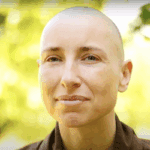
Sister True Dedication is a former journalist and monastic Dharma Teacher ordained by Thich Nhat Hanh. The editor and author of the commentary in Zen and the Art of Saving the Planet, Sister True Dedication has been a Zen Buddhist nun since 2008. Before entering the monastery, Sister True Dedication studied History and Political Thought at Cambridge University and worked as a journalist for BBC News in London. In the early years of her monastic training, she assisted Thich Nhat Hanh and Sister Chan Khong in their engaged Buddhist actions for human rights, religious freedom, applied ethics, and ecology. She is co-founder of the international Wake Up Movement, a community of young meditators who are finding new ways to combine mindfulness and engaged Buddhism. Today, she contributes her time and energy to guiding a new generation of young monastics and to editing Thich Nhat Hanh’s writings, in particular his recent books on Buddhism and ecology, including Love Letter to the Earth (2013), The Art of Living (2017), and Zen and the Art of Saving the Planet (2021).
Pieces on One Earth Sangha
Sophie Strand is a writer based in the Hudson Valley who focuses on the intersection of spirituality, storytelling, and ecology. Her poems and essays have appeared in numerous projects and publications, including Spirituality & Health, Atmos, Braided Way, and Art PAPERS. She is the author of The Flowering Wand, The Madonna Secret, and the forthcoming memoir The Body Is a Doorway as well as the creator of the popular Substack “Make Me Good Soil.” You can follow her work on Instagram @cosmogyny.

Vanessa Machado de Oliveira is the former Dean of the Faculty of Education at the University of Victoria and former Canada Research Chair in Race, Inequalities and Global Change at the University of British Columbia. She is a Brazilian/Canadian educator, artist, and researcher who has spent over three decades tracing the architecture and aftershocks of modernity: its promises, violences, and delusions of separation. Her work invites a reckoning with the ontological assumptions driving systemic harm and extinction-level thinking. She has published more than 100 academic papers and is the author of Hospicing Modernity and Outgrowing Modernity, co-author of Burnout From Humans: A Little Book About AI That Is Not About AI, and a co-weaver of the Gesturing Towards Decolonial Futures arts and research collective.
Pieces on One Earth Sangha
How Much Does It Cost?
Registration fees help cover the significant costs of our offerings. Because we have no physical building, it may seem like we have no costs. This is not so. While we also depend on the practice of dana or generosity, the truth is that, like many convert-Dharma institutions, we lack the funding to provide our programs based on dana alone.
The basic rate for registration is $750 USD. We offer two sliding scales of registration fees as well as need-based discounts.
Sliding Scale
We invite you to consider your ability to pay as a function of your geographic and social location as well as other circumstances. Our sliding fee scales are based on your relative financial standing in a global context.1 We are grateful to the folks at Network Weaver for this framework. (https://networkweaver.com/brave-questions-recalculating-pay-equity/)
Considerations include:
- historical discrimination and disenfranchisement faced by your peoples;
- your financial wealth (do you have retirement savings?);
- your access to income and financial wealth, both current and anticipated (how easily could you earn more income compared to other people in your country and in the world? do you expect to receive an inheritance?);
- people counting on your financial livelihood including dependents and community members;
- and the socio-economic conditions of your locale (relative to other places in your country and in the world).
For people with medium, high, or very high access to wealth in the global context:
- Basic rate: $750 USD
- Supporter: $1,000 USD
- Sustainer: $1,500 USD
For people with relatively low access to wealth in the global context:
- Basic rate: $275 USD
- Supporter: $350 USD
- Sustainer: $500 USD
Convert USD into your currency with this currency converter (starting with $750 USD).
It is our policy that no one is ever turned away for lack of funds. Need-based discounts are available to those who are unable to afford the basic rate. Email to inquire about these discounts.
I'm Interested. What Do I Do Next?
- Applications are now open for both the March and June cohorts.
- Since this course is best experienced with and among your peers, we invite you to share this page with colleagues who just might become your valued journey mates.
Gratitude
One Earth Sangha is 13 years old this year, and we could not have made it this far without the generosity and support of our guiding teachers, this training’s session leaders, our Sangha, and of course the Earth. We are particularly grateful to those who have taken the training in the past and provided valuable feedback, as well as those who have bravely and kindly supported others in this experience by leading local and online groups.
I still have questions.
If you don’t see your question answered above, let us know by emailing and we’ll do our best!