
In the wake of the 2024 Presidential election in the United States earlier this week, many Americans are experiencing loss and heartbreak.
We grieve a promising world we envisioned, but will not yet be. We ache for a country misaligned with the grand aspirations we hold close to heart, for all our sakes, but which seem unattainable now. We feel exhausted, broken, powerless.
“That’s alright. Take it from me.” Avalokiteshvara whispers, “Even bodhisattvas shatter.”
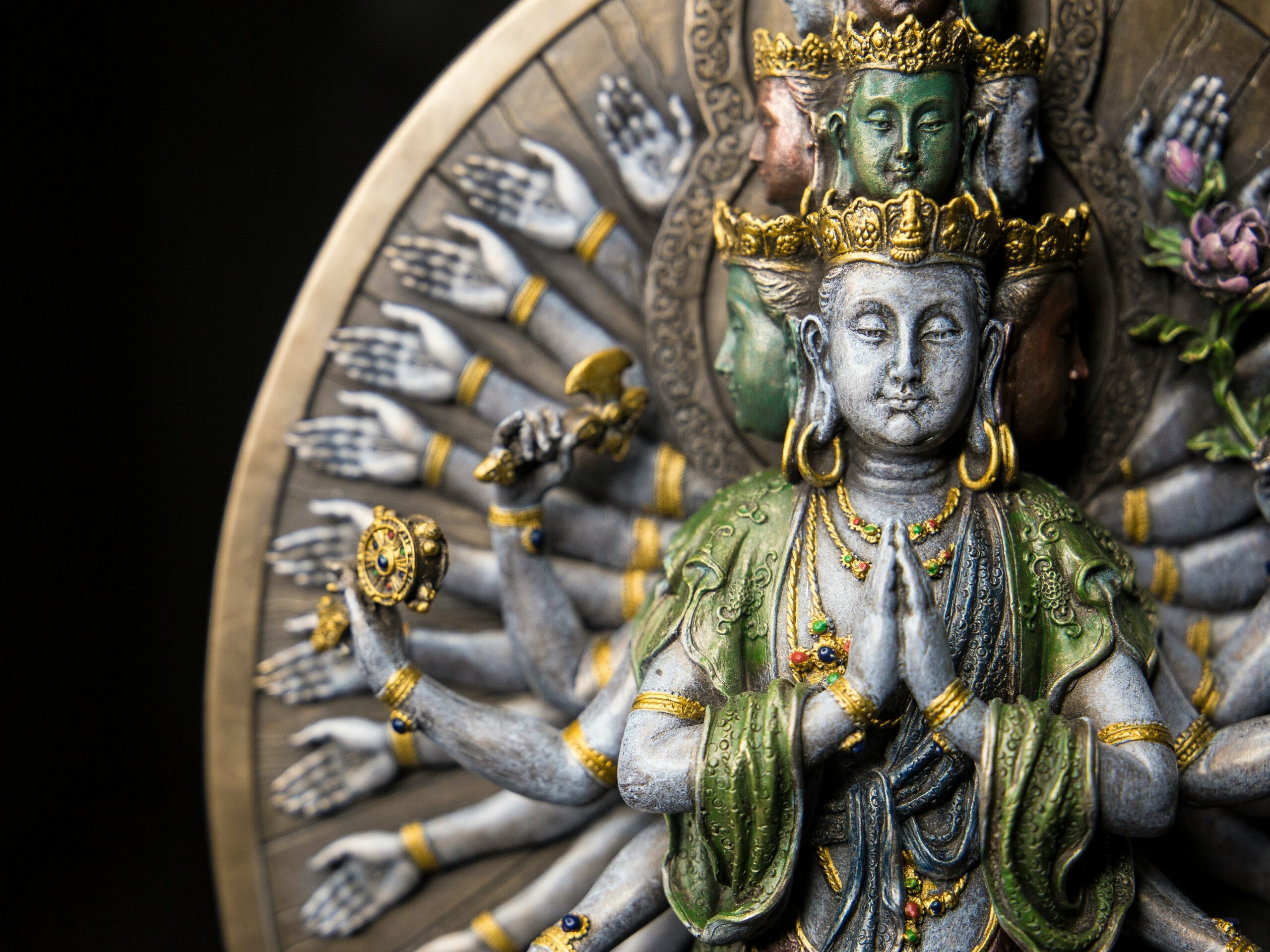
Avalokiteshvara, or Chenrezig in Tibetan, is the beloved bodhisattva of compassion, who takes various forms, including 1000-arm Avalokiteshvara. A simplified version of his story relates that Avalokiteshvara was born from a tear of resplendent light that fell from the right eye of his guru, Amitabha, the Buddha of Immeasurable Light. (The bodhisattva Tara arose at the same time, from the tear of light emerging from Amitabha’s left eye.)
They pause, and grieve, weep and wail, and heal. And eventually, when their time has come, bodhisattvas rise.
An embodiment of bodhicitta, the awakening mind, Avalokiteshvara immediately undertakes the extraordinary resolve to remain in samsara until he personally has emptied it of all suffering beings. Not content to stop there, Avalokiteshvara also vows that, should he ever waver in the slightest from the altruistic mindset of bodhicitta, he shall splinter into pieces.
For eons, Avalokiteshvara emanates the benevolent and powerful wisdom light of enlightened action throughout all the realms of samsara, liberating countless beings and establishing them in buddhahood. As befits his name, “The One Whose Eyes Look Upon the World,” at the close of this time, eager to see the fruits of his enlightened action, Avalokiteshvara looks about from the highest peak in the snowy land of Tibet, only to find that samsara is as populous as ever. But a bodhisattva’s vow is sturdy.
Undaunted, Avalokiteshvara continues, for longer still. Again, upon casting his loving gaze throughout samsara, he sees that there are no fewer beings than before. But a bodhisattva’s vow endures. Unwavering, Avalokiteshvara continues even longer, freeing infinite beings from samsara. When again he scans the world, certain that, this time, he has made progress, his tender eyes find there has been no change in number.
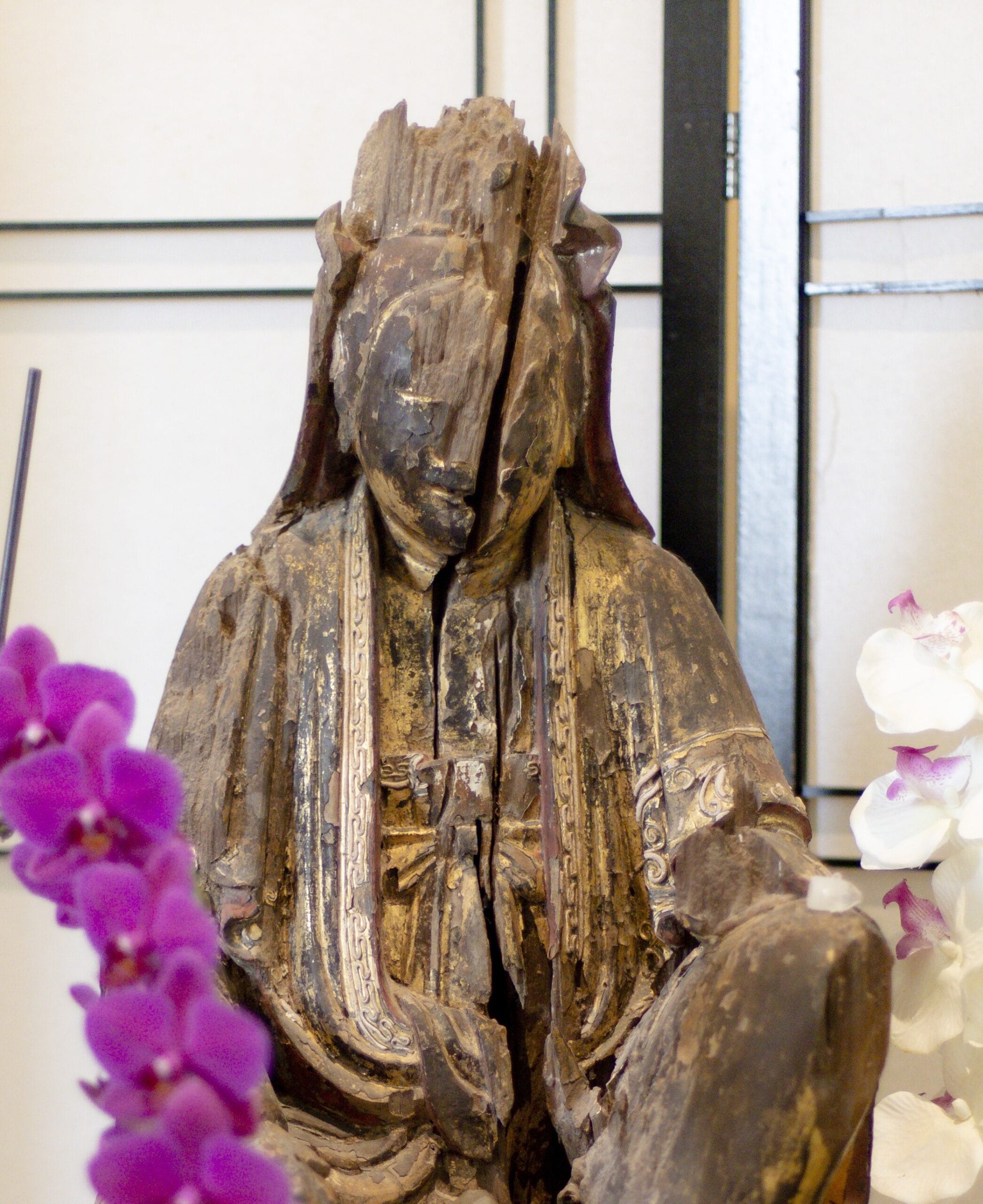
Disheartened, Avalokiteshvara gives up. He thinks, “There will never be an end to samsara. It will never be empty. I cannot do this anymore. I shall abide in blissful peace for my own sake.” But the power of a bodhisattva’s vow is true. Instantly, Avalokiteshvara shatters, literally falling to pieces.
Experiencing unimaginable anguish, he shudders and weeps. But a bodhisattva’s refuge never falters. Avalokiteshvara’s agony invokes the Buddha Amitabha, who spontaneously appears at Avalokiteshvara’s side. Amitabha lovingly pieces him together anew. Avalokiteshvara is no longer the same. Nor is he entirely different.
From his shattering experience, he arises reshaped. Previously, he sat in cross-legged meditation, brilliant white in color, with one face and four arms. He now stands in equipoise, radiant white and topped by eleven heads, red, white, and green, arranged in tiers. His one thousand arms form a circle surrounding his torso, with an eye in each palm. Each of these elements embody aspects of his reinforced capacity to benefit all beings.
This is the Avalokiteshvara who whispers in my ear. I find in his story an inspiring allegory for facing life’s greatest challenges, even this one.
Like us, Avalokiteshvara did not give up the first time. Nor the second. He keeps at it. It is the last straw that breaks him, like this latest one has broken us. His heartbreak is not a punishment. It originates from his resolve, a testament to his love.
Yet he does not bounce back instantly, ready to dust off his vow and take it up once more. Felled by the agony of discouragement, he experiences the ache of his loss. In this unique time of collective disbelief and sorrow, we too can grant ourselves the time to fall, to experience our pain, to tremble and sob. We need not rise up instantaneously, blind to our own care. Even bodhisattvas pause.
Avalokiteshvara does not rush to fix himself. Nor does he deny his pain. Unashamed, his heart cries out for relief. We too, need not repress our hurt, nor pretend we are just as we were on Tuesday morning, burgeoning with hope and possibility. Even bodhisattvas grieve.
Then, the force of Avalokiteshvara’s refuge in the Buddha Amitabha takes over. Amitabha responds immediately. Avalokiteshvara’s heart is wide open, so Amitabha can provide the help he needs. Even bodhisattvas must heal.
Out of the very discouragement that broke him for a time, Avalokiteshvara’s commitment fashions new instruments for the way ahead.
In the depths of despair, when we cannot imagine what comes next, nor muster the strength to do it even if we knew, we need not worry. Refuge, too, is interdependent, each part acting in concert with the other. Our heartfelt going for refuge calls upon the Dharma automatically, and this surest object of refuge responds. To the extent we can remain receptive, its unfailing aid revives our bodhisattva hearts.
Out of the very discouragement that broke him for a time, Avalokiteshvara’s commitment fashions new instruments for the way ahead. Like his once shattered vow, Avalokiteshvara is transformed, standing in his fresh power. His previously intact form is now a mosaic of love, capacity, and resourcefulness—the traces of his fall displayed prominently, as badges of honor. When he looks out upon samsara, still he sees, “There will never be an end to samsara. It will never be empty.” Renewed and clear-eyed, he responds:
For as long as space remains,
For as long as sentient beings remain,
May I, too, remain,
To dispel the suffering of the world.
The scope of a bodhisattva’s vow is immense.
So, yes, even bodhisattvas shatter. They pause, and grieve, weep and wail, and heal. And eventually, when their time has come, bodhisattvas rise.
As shall we, one by one at first, then increasingly, side by side. Looking out across our flawed yet beautiful country, and at the work ahead, we will understand that it was never going to be easy. However Tuesday ended, there was no lush bed of laurels waiting for us to rest upon indefinitely. Certainly, this will be harder than we imagined. But the force of our solidarity is mighty.
May all beings embody fully the love, power, and wisdom of buddhahood, the true nature of mind.
This article was originally published on Prajna Fire. It is reprinted here with permission.