
Perhaps you have the sense that this collective situation we’re in, it’s getting harder to hold. With the heat, the headlines, the losses that keep coming, perhaps there’s a quiet question underneath: what am I supposed to do with all this?
Most of us reach for something to make it bearable. Some of it helps for a while. Little of it lets us see and understand what’s actually happening.
The EcoSattva Training offers eight sessions of teaching, practice, and companionship for anyone longing for another way: steady enough to stay with it, clear enough to see what’s needed, and moved by love.
Come find out what becomes possible when we turn toward it, together.
2026-2027 Course Status and Key Dates
- Individual registration is now open. Register here.
- Group registrations are open now. Experienced and aspiring facilitators can create your group now.
- Individuals seeking groups: Browse our group directory and/or add yourself to our list of individuals seeking groups.
- Course materials for the new version will become available starting October 25th.
‘For anyone who’s yearning for a way to meet the often agonizing challenges of this time with a clear mind, a steady heart, a resilient body and a ferocious spirit, One Earth Sangha’s EcoSattva Training is a beautifully-designed and meticulously-crafted container. I can’t recommend it enough.’
Welcome to the edge.
Being one human as the Earth undergoes a dramatic shift, one set in motion by the systems all of us propel forward even if we try otherwise. This is hard.
The urge to look away, the story of powerlessness, the retreat into numbness, the righteous rage that wears all the softness from our hearts, the allure of enjoying what’s left while it lasts: at some point we might get the sense that these strategies themselves have taken over our lives.
It’s not that we’re broken. Each of these has its own logic and offers real relief, at least for a while. Most of us move among them, sometimes in a single day. They help us get through it, and perhaps we’ve decided on some level that this is what’s available. Yet they keep us on the surface of a moment calling us into depth.
Right where the familiar ways begin to lose their appeal, growing just a little less convincing, something new becomes possible. The way forward is under our feet. When we are willing to be right here, the Path unfolds before us.
For millennia, the Buddha’s teachings have shown us how to stay with what is hard: to feel it fully, see it clearly and with compassion, and respond from there with kindness. Like an ancient open-source project, they have been shared, recast, and renewed by teachers in every generation. They meet us now, amid this moment of global reckoning, offering something the familiar strategies never could: a way of living inside uncertainty that is honest about our agency, rooted in an unshakable steadiness, and alive to a joy that cannot be destroyed.
The EcoSattva Training invites us into that way, as a journey of practice. In this moment of edges, it can help us find our footing and each other. We might come to know this changing Earth as a profound and beloved teacher.
Learn More about the EcoSattva Training
Overview of the Course
The EcoSattva Training is an eight-part series designed to support you in developing your response, internal and external, to a changing world. We’ll offer new insights from multiple Dharma traditions as well as the growing field of climate psychology as we soothe these tender bodies, hearts and minds. Supported by these teachings and one another, participants can discover and cultivate a way forward.
The course will begin at the level of our internal experience, a good place to start given our pervasive stress. Climate psychologists are demonstrating that these crises are traumatizing, with the attendant adaptations to trauma showing up in both our individual and collective defenses. We will spend time in this course understanding that dynamic and then bring in specific Dharma and trauma-informed practices that can relieve our ecological distress.
Having cultivated an inner landscape of kindness and calm, we’ll begin to challenge the views and patterns that only contribute to suffering, individually and collectively. We will explore the intersections between ecological harm with other forms of objectification and exploitation, especially in regards to race, revealing their common roots. We’ll then open to the spaces of potent uncertainty, allowing ourselves to lean in, let go, and listen to what wants to emerge.
In the latter section of the course, we will explore diverse forms of response: changes to our individual habits, necessary refusals to cooperate with systems of domination, and gateways to collective action.
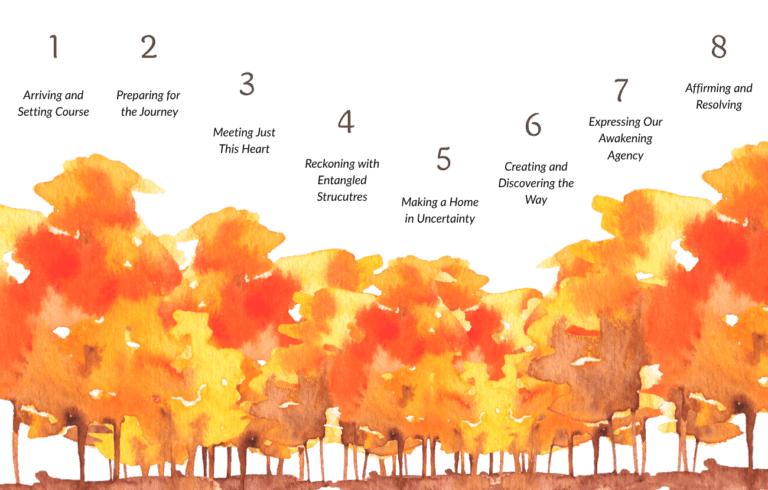
- Session One: Arriving and Setting a Course with Kaira Jewel Lingo
- We’ll begin by gathering and reflecting on our global situation, mapping out our journey, and setting the conditions for empowered, compassionate response.
- Session Two: Preparing for the Journey with Damchö Diana Finnegan
- In this journey we are likely to meet fear, grief, anger, and other difficult emotions. In investigating these strong energies, we can discover spiritual resources that can help us hold them.
- Session Three: Meeting just this Heart with Britt Wray
- We need to understand how it is we found ourselves in this astonishing situation. Understanding the causes and conditions that led us here can unlock an openness that is crucial to mindful engagement.
- Session Four: Reckoning with Entangled Structures with Kritee Kanko, Larry Ward, and Peggy Ward
- Ecological harm is inextricably tied to systems of oppression. Participants are invited to explore, with compassionate accountability, how the dominant structures objectify Earth and all her beings, ultimately harming all.
- Session Five: Making a Home in Uncertainty with Lama Willa Blythe Baker
- To be authentically helpful necessitates radical comfort with the unknown. We must metabolize our mind-boggling, heartrending situation and learn to recognize the endless possibilities contained therein.
- Session Six: Creating and Discovering The Way
- Continuing in the relational spiritual task, attunement with the unknown, we’ll open further to so much more than the conventional holding of that truth. We’ll welcome whatever arises, from nothing to mystical everything.
- Session Seven: Expressing Our Awakening Agency
- Equipped with a deeply rooted sense of our belonging and calling, we turn outward, discovering the domains of our EcoSattva action.
- Session Eight: Affirming and Resolving
- In the closing session, we’ll return to our individual aspirations or visions to refine and affirm, and explore the boundless potential of Sangha as the heart of our engagement.
What's new this version?
This year’s update is centered around grounding our Dharma practice in our current reality and showing up in our fullest expression to our community and what the world needs of us. We discover our manifestation of the middle path while reconciling with the paradox of the teachings of Dharma.
We are excited to offer new EcoDharma from Kirsten Rudestam, Kazu Haga, Kristin Barker, and Lou Leonard to support our practice.
Many in our community return to this training again and again. The experience is never the same and evolves with our Dharma journey. What’s more, those who have participated in any previous version of the training are eligible for a special 50% “Renewer” discount. Whether you are a new traveler or a seasoned explorer, we hope you’ll join us.
Who is this for?
- You are suffering from ecological crises manifesting around us, and you don’t want to hold this pain alone;
- You are interested in a response to climate crises that goes beyond both aversion for the supposed enemies and retreat into spiritual bypass;
- You are willing to contend with the ways in which we are personally and collectively entangled with modernity even if that brings up feelings of discomfort;
- You see the possibility of being hospitable to challenges, without rushing towards a sense of resolution;
- You are interested in nourishing a spiritual practice that can in turn support wise and wholesome action for a radically changing world with various unknowable futures, without solidifying apocalyptic ideologies;
- You see the potential for creating a sacred container that can hold your own uncertainty and support others in doing the same;
- The prospect of a brave and tender confrontation, supported by community, calls to you.
‘The training supported me in understanding myself in my inner and outer work as an environmental activist and educator. Moreover, it gave me hope and a lot of tools to go forward and overcome climate despair. It clarified my motivation and path forward as a Buddhist in this messy world with so many crises.’
How can I participate?
You decide how you want to approach the EcoSattva Training. This is a self-paced, flexible course designed to fit a wide variety of schedules and circumstances. There is no fixed schedule for participation, and you will retain access to the materials indefinitely.
It’s better together.
If it works with your circumstances, we recommend taking the training as part of a group. Group members can normalize each other’s experience while offering comfort, insights, and inspiration. Groups can be open (listed in our directory) or closed (private), online or in-person. In person groups help build ongoing connection and resilience at the local level. Online groups can offer a wonderful experience of a globally responsive community. Members of groups of three or more participants receive a 25% discount on registration.
If you find a group you wish to join, send the organizer an email and they will provide you with a link to register as a member. If you can’t find a group suitable to your needs, we invite you to create one. Even if you don’t have experience with leading a group, we are here to support you with our Invitation Template and Group Facilitator’s Guide, and you are welcome to email us at if you have questions.
Watch this space for other virtual groups to join for those interested.
Who will be featured?

Kaira Jewel Lingo is a Dharma teacher with a lifelong interest in spirituality and social justice. Her work continues the Engaged Buddhism developed by Thich Nhat Hanh, and she draws inspiration from her parents’ lives of service and her dad’s work with Martin Luther King, Jr. After living as an ordained nun for 15 years in Thich Nhat Hanh’s monastic community, Kaira Jewel now teaches internationally in the Zen lineage and the Vipassana tradition, as well as in secular mindfulness, at the intersection of racial, climate and social justice with a focus on Black, Indigenous, and People of Color, and activists, as well as artists, educators, families, and youth. Based in New York, she offers spiritual mentoring to groups and is author of We Were Made for These Times: Ten Lessons in Moving through Change, Loss and Disruption and co-author of Healing Our Way Home: Black Buddhist Teachings on Ancestors, Joy and Liberation. Her upcoming events and teachings can be found at www.kairajewel.com.
Pieces on One Earth Sangha
Britt Wray, PhD is a Postdoctoral Fellow in Human and Planetary Health at Stanford University and the London School of Hygiene and Tropical Medicine, eco-anxiety researcher, writer, creator of the Unthinkable Times newsletter about “staying sane in the climate crisis” and author of Generation Dread: Finding Purpose in an Age of Climate Crisis. Her website is brittwray.org.
Pieces on One Earth Sangha
Kazu Haga is a trainer and practitioner of nonviolence and restorative justice, a core member of the Fierce Vulnerability Network, a founding core member of the Ahimsa Collective, a Jam facilitator and author of Healing Resistance: A Radically Different Response to Harm and Fierce Vulnerability: Healing from Trauma, Emerging through Collapse. He works with incarcerated people, youth, and activists from around the country and has over 25 years of experience in nonviolence and social change work. He is a resident of the Canticle Farm community on Lisjan Ohlone land, Oakland, CA, where he lives with his family. You can find out more about his work at his website.
Pieces on One Earth Sangha
Adam Lobel, Ph.D, practices at the threshold of ecologies, Buddhist meditation and philosophy, contemplative education, and psycho-social political change. His work in the world weaves these practices together into the Four Fields. Adam is a scholar-practitioner of philosophy and religion, focusing on Dzogchen Tibetan Buddhism and contemporary theory. He is active in contemplative design and research. A teacher of Ecopsychology and a Focusing professional, he is curious about cultural therapeutics for social upheavals. He leads ecodharma workshops, teaches in the Ecosattva Training, is a Guiding Teacher for One Earth Sangha, a GreenFaith fellow, and is active in environmental justice movements. He helped found 4F Regeneration, an ecological consulting organization to support individuals and nonprofits on the front lines of protecting the earth. He lives in Pittsburgh, PA with his partner and two kids where he protects lands from the petrochemical industry. For more on Adam’s practices: www.releasement.org
Pieces on One Earth Sangha
Dr. Larry Ward (1948—2025) was a senior teacher in Buddhist Zen Master Thich Nhat Hanh’s Plum Village tradition. He brought twenty five years of international experience in organizational change and local community renewal to his work as director of the Lotus Institute and as an advisor to the Executive Mind Leadership Institute at the Drucker School of Management. He had a PhD in Religious Studies with an emphasis on Buddhism and the neuroscience of meditation. Larry was a knowledgeable, charismatic and inspirational teacher, offering insights with personal stories and resounding clarity that expressed his dharma name, “True Great Sound.” He was a co-founder, with Dr. Peggy Rowe Ward, of The Lotus Institute. Larry was the author of America’s Racial Karma and co-author with Dr. Peggy Rowe Ward of Love’s Garden: A Guide to Mindful Relationships.
Pieces on One Earth Sangha
Mark is an inner and outer explorer, who has devotedly studied mindfulness meditation practices for three decades. He is passionate about sharing the power of meditation and has taught mindfulness workshops and meditation retreats in six continents for the past twenty years. Mark is a senior meditation teacher at Spirit Rock Meditation Center and has taught there since 2000. Through his organization Awake in the Wild, he shares his passion for integrating meditation and nature.
Pieces on One Earth Sangha
Kritee(dharma name Kanko) is a Climate Scientist, Zen Buddhist priest, Educator & Founding Spiritual Director ofBoundless in Motion, a 501(c) nonprofit based in Boulder (Colorado). She served as a leading scientist in the Climate Smart Agriculture program at Environmental Defense Fund for about 12 years. She is also an ordained teacher in the Rinzai Zen lineage of Cold Mountain and a co-founder ofRocky Mountain Ecodharma Retreat Center. She has served as faculty for courses or retreats at the intersection of Climate justice, Trauma healing and Spirituality for many organizations including Stanford University, World Council of Churches, San Francisco Zen Center, Mind & Life Institute, and Al Gore’s Climate Reality. Her experience is that identifying and releasing our personal and ecological grief in presence of a loving community is necessary toreindigenizeour ecosystems in this era of globalpolycrisis. Her articles, podcasts and interviews have appeared in the New York Times, BBC, Washington Post, Harvard Health, Yale Climate Connections, California Public Radio and Post Carbon Institute (See a fewhere). For more information, visit herwebsite.
Pieces on One Earth Sangha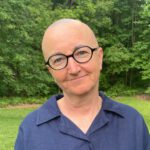
Damchö is spiritual director and a founder of Comunidad Dharmadatta, one of the largest Buddhist practice communities serving Latin America. Dharmadatta Community understands the path to liberation to be a primarily collective rather than individual path. In her teachings, Damchö transmits an earth-based vision of the Dharma in which care for our more-than-human kin is integral to spiritual practice. She has a PhD from the University of Wisconsin-Madison in gender and ethics in Sanskrit and Tibetan Buddhist narratives, and is translator and co-editor of Interconnected: Embracing Life in our Global Society.
Pieces on One Earth Sangha
Lama Willa Miller is the Founder and Spiritual Director of Natural Dharma Fellowship in Boston, MA and its retreat center Wonderwell Mountain Refuge in Springfield, NH. She is Visiting Lecturer in Buddhist Ministry at Harvard Divinity School. As a writer and editor, her work has been published in Journal of the International Association of Buddhist Studies, Buddhadharma, and the Tibet Journal. Willa’s teaching interests include compassion, non-dual embodiment and contemplative care.
Pieces on One Earth Sangha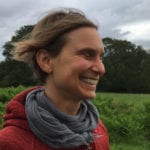
Kirsten Rudestam is an environmental educator, wilderness guide, and meditation teacher. She has a PhD in Environmental Sociology from the University of California, Santa Cruz where she studied environmental justice and Indigenous water practices. She has fifteen years of experience teaching field-based and classroom-based college courses in environmental studies and sociology, is trained as a vision fast guide through the School of Lost Borders and is a facilitator for Joanna Macy’s Work that Reconnects. Kirsten has been practicing vipassana meditation since 2001. She, Gil Fronsdal, and Susie Harrington are the co-founders and core faculty for the Sati Center Buddhist Eco-Chaplaincy training program. Those interested in joining the program in the future are invited to contact them at .
Pieces on One Earth Sangha
Myokei Caine-Barrett, Shonin, was the first American woman and the first person of African Japanese descent to receive full ordination as a Nichiren priest. Today, she is the bishop of the Nichiren Shu Buddhist Order of North America. Based in Houston, where she is the guiding teacher of Myoken-ji Temple, she also leads two prison sanghas. She currently serves on the boards of Lion’s Roar and Dharma Relief 2 (a project providing financial support for Buddhist Teachers of Black African Descent). She is also involved in the Garden Initiative, a mentoring project for Black Women Religious Leaders. She has been active in Healing Warrior Hearts (a program for veterans returning home) and The Gathering: Buddhist Teachers of Black African Descent. Myokei Shonin recently became 1 of 3 westerners to participate in Aragyo (austerities practice) in Okayama and become a Saijo Inari priest.
Pieces on One Earth Sangha
Tim Ream is a long-time Earth activist and Soto Zen practitioner. He received lay ordination from Tenshin Reb Anderson in 1994 and has engaged since in repeated, intensive residential practice, mostly at Tassajara Zen Mountain Center and Green Gulch Farm. Tim is an organizer, campaigner, writer, and environmental attorney. His activism ranges from direct action and civil disobedience like tree-sitting and road blockading to successful lawsuits to protect wolves and other species. He is the author of Fallen Water: A novel of Zen and Earth.
Pieces on One Earth Sangha
Kristin is co-founder and director of One Earth Sangha whose mission is to cultivate a Buddhist response to ecological crises. She is a graduate of Spirit Rock’s Community Dharma Leader program and now teaches with the Insight Meditation Community of Washington (DC). As a co-founder of White Awake, Kristin has been supporting white people since 2011 with a Dharma approach to uprooting racism in ourselves and in our world. With a background in software engineering as well as environmental management, she has worked at several international environmental organizations. She is a GreenFaith Fellow and serves on the advisory board of Project Inside Out as well as the steering committee for Interfaith Power & Light DMV. Kristin was born and raised in northern New Mexico and currently lives in Washington DC, traditional lands of the Piscataway peoples.
Pieces on One Earth Sangha
Lou is co-founder and principal advisor of One Earth Sangha. He is a life-long environmentalist who has worked to advance laws, policies and practices that promote care for the Earth and the people and communities that call it home. Lou discovered the dharma as part of his search for balance and support in the face of the difficult emotions that arise as we dedicate ourselves to healing the world and promoting social change. He’s worked in government, civil society, academia, and the private sector, including serving as Senior Vice President at World Wildlife Fund where he led the climate change program for over a decade. Lou currently serves as Dean of the Falk School of Sustainability & Environment at Chatham University supporting students of all ages who are training to advance climate and food justice. Lou is deeply grateful for the refuge he has found in the dharma and the teachers who have helped him find it.
Pieces on One Earth Sangha
How might the groups use the material?
Each session can easily support a group gathering of 60 to 90 minutes. We recommend that group members watch the session videos on their own before meeting, to maximize time for sharing and connecting. The meeting should provide time to do a brief opening, explore the provided inquiries, engage in discussion, cover logistics and close. You might choose to add an extended opening meditation. Each session will have its own page on our site that contains a sample agenda, the main video, a set of inquiries to choose from and supportive resources. Between sessions, participants might be encouraged to practice the guided meditations included in the training materials. Of course, groups are invited to use what works for them, removing and adding as will be most helpful.
Here’s a sample agenda for a 90-minute gathering:
- Opening: 30 min
- Group meditation (possibly using one of the provided guided meditations)
- Land acknowledgment and prayer
- Personal check-in
- Discussion and Practices: 45 min
- Reflect on the most recent session: 15 min
- Explore inquiries or contemplations, individually in meditation, journaling, in dyads or groups: 20 min
For group sharing methods, you might use 1-2-4-all, Conversation Cafe, or other approaches found on Liberating Structures - Discuss practices to explore between the current and next meeting: 10 min
- Closing: 15 min
- Logistics and host appreciation
- Silence or other ceremonial ending
- Dedication of merit
Our Group Facilitator’s Guide covers alternatives to this agenda, goes into more detail and offers helpful tools.
How much does it cost?
Sliding Scales
We invite you to consider your ability to pay as a function of your geographic and social location as well as other circumstances. Our sliding fee scales are based on your relative financial standing in a global context.1 We are grateful to the folks at Network Weaver for this framework. (https://networkweaver.com/brave-questions-recalculating-pay-equity/) Considerations include:- historical discrimination and disenfranchisement faced by your peoples;
- your financial wealth (do you have retirement savings?);
- your access to income and financial wealth, both current and anticipated (how easily could you earn more income compared to other people in your country and in the world? do you expect to receive an inheritance?);
- people counting on your financial livelihood including dependents and community members;
- and the socio-economic conditions of your locale (relative to other places in your country and in the world).
- Basic rate: $175 USD (around $22 per session)
- Supporter: $250 USD
- Sustainer: $500 USD
- Basic rate: $75 USD (around $9.50 per session)
- Supporter: $100 USD
- Sustainer: $150 USD
Additional Discount for Group Members
While groups aren’t for everyone, we suggest that your course experience will be significantly improved if you are part of a group, whether online or in-person. Once your group registers three or more participants, you each will receive a 25% discount on the registration fee of your choice. Facilitators receive a unique registration link that can be shared with potential group members in order to unlock the discount. If you are a member of a group and haven’t received the link, contact your facilitator.Additional Discount for Returning Participants
If you have registered for a previous version of the EcoSattva Training, and you would like to join us again, you should receive by email a unique code for 50% off the registration fee. If you did not receive a discount code, please email us at .‘There is so much state-of-the-art knowledge and so much timeless wisdom in this Training – I deeply recommend it to everyone and every group willing to start their Ecosattva journey. Which means to commit themselves to actively abiding in this very world for the good of the Earth, all living beings on it, including themselves.’
I'm interested. What do I do next?
- Registration for groups is now open. Individual registration opens on September 20th.
- Create a group. Group organizer can choose to form a public or private group with new or existing community members. You can also explore our directory of open groups, or add your name to our Individuals Seeking Groups list.
- Sign up for our mailing list to stay up-to-date on the latest news about the EcoSattva Training.
‘The EcoSattva Training from One Earth Sangha is an excellent support for integrating our Buddhist practice with the most important issue of our time. Great resources all in one place, to come back to at any time. I appreciate the combination of a clear structure with an open time frame.’
Gratitude
One Earth Sangha is more than 12 years old this year, and we could not have made it this far without the generosity and support of our guiding teachers, this training’s session leaders, our Sangha, and of course the Earth. We are particularly grateful to those who have taken the training in the past and provided valuable feedback, as well as those who have bravely and kindly supported others in this experience by leading local and online groups.
We would also like to thank our team members, who have combined their talents to bring this series to life, as well as Jeff Wessman of Inner Active Media for the video titles.
How can I help?
So glad you asked! Besides spreading the word and possibly starting a group, we have specific volunteer needs to support the training and would be delighted to waive the registration fee for those who can help out. Even if none of these works for you, perhaps you know someone who might be interested! Let us know by emailing and we’ll take it from there. Check out our volunteer opportunities page and see if one of those fits you!